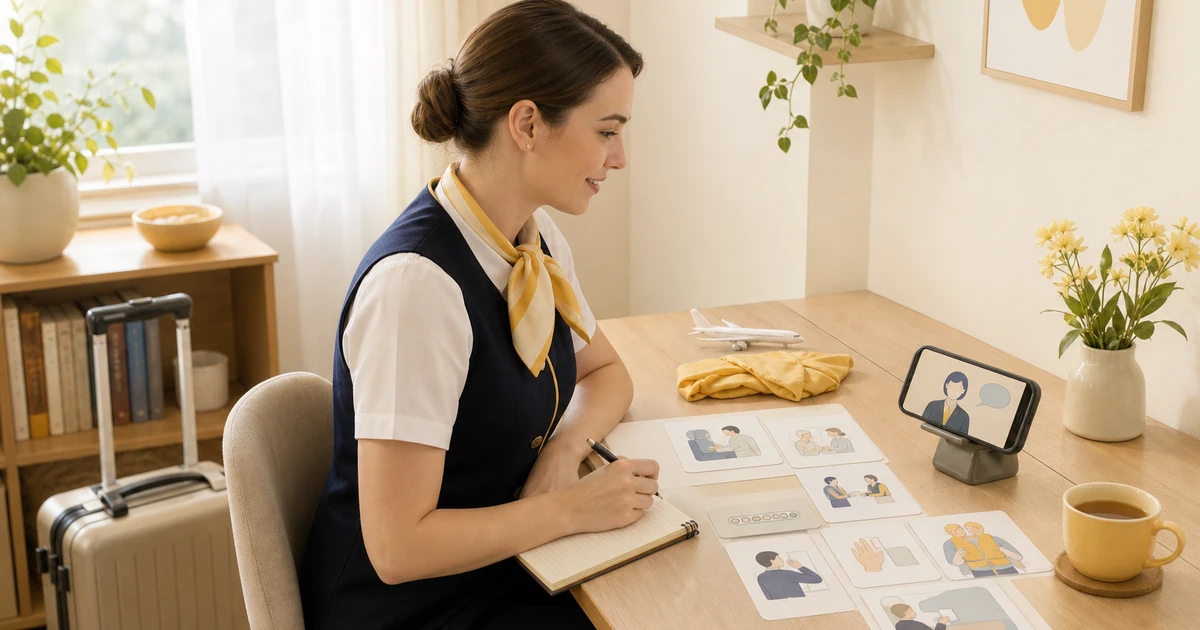
For flight attendants, online Japanese lessons are most useful when they focus on the exact speaking tasks you use at work: passenger help, announcements, and emergencies. A one-on-one tutor can help you rehearse the wording, pace, and tone you need in real service situations, not just in textbook examples.
If you are still comparing lesson formats, Is It Worth Paying for Japanese Lessons? is a useful place to start. If you already know you want to try a lesson, this page will show you what to practice first and how a focused LINE lesson can work.
What Flight Attendants Need Most
The main goal is clear, calm Japanese that works under pressure. Flight attendants do not need every possible grammar pattern. They need short, polite lines that can be adapted when a passenger changes the question or when the situation becomes more urgent.
From a teacher's perspective, the biggest value often comes from turning one line into three or four usable versions. That way, you can answer a passenger, make an announcement, or handle a problem without freezing when the wording changes a little.
If you want to decide whether this kind of coaching fits your goals, Japanese Free Trial Lesson Questions to Ask is a helpful guide for preparing your first conversation.
What to Practice First
The best starting point is a small set of phrases for guidance, waiting, help, announcements, and emergencies. Once those are stable, a teacher can help you expand them into role-play and speed practice.
Japanese | Romaji | English Meaning |
|---|---|---|
ご案内します | go-annai shimasu | I will guide you / inform you |
少々お待ちください | shōshō omachi kudasai | Please wait a moment |
こちらへどうぞ | kochira e dōzo | This way, please |
お手伝いします | otetsudai shimasu | I will help you |
ただいま機内アナウンスを行います | tadaima kinai anaunsu o okonaimasu | We will make a cabin announcement now |
緊急事態です | kinkyū jitai desu | This is an emergency |
A useful cultural note: in Japanese service language, calm and concise often sounds better than long and elaborate. Clear, polite wording usually helps passengers more than a very formal sentence that takes too long to say.
Three Role-Play Scenarios
Role-play is where online Japanese lessons become practical. A teacher can put you in the exact situation, listen to your response, and give teacher feedback on what sounded natural and what sounded too long, too blunt, or too hard to say quickly.
- Passenger help
A passenger asks where to go, how to store luggage, or whether something is available. The best practice is a short answer first, then a polite instruction.
Teacher feedback example: keep the opening brief, use one clear request, and avoid adding extra explanation before the passenger has understood the first line.
- Cabin announcements
Announcements need clear rhythm, simple vocabulary, and steady pacing. This matters whether you are giving boarding information, a reminder, or a service update.
Teacher feedback example: your sentence may be correct on paper, but in spoken Japanese it can sound too dense. A teacher can help you split it into easier chunks.
- Emergencies
In emergencies, the language should be direct, calm, and easy to hear. That includes urgent instructions, safety reminders, and simple explanations.
Teacher feedback example: lead with the action or safety instruction first. Do not hide the main point inside a long sentence.
Useful lines to rehearse in context:
お客様、こちらへどうぞ。
Okyaku-sama, kochira e dōzo.
This way, please, valued customer.
少々お待ちください。
Shōshō omachi kudasai.
Please wait a moment.
ただいま機内アナウンスを行います。
Tadaima kinai anaunsu o okonaimasu.
We will make a cabin announcement now.
緊急事態です。落ち着いてください。
Kinkyū jitai desu. Ochitsuite kudasai.
This is an emergency. Please stay calm.
A Sample 25-Minute LINE Lesson
Kind's standard one-on-one lessons are 25 minutes, so the lesson needs to stay focused. A simple LINE lesson flow works well for flight attendants because it keeps the practice close to real speech.
A practical flow is:
- Warm-up: one short check-in about the situation you want to practice, such as passenger help or an onboard announcement.
- Target speaking task: one role-play scene with a clear goal.
- Teacher feedback: correction on word choice, politeness, vowel length, small っ timing, and sentence-ending intonation.
- Repeat: say the same line again with the correction built in.
That kind of speak-correct-repeat loop is often more useful than trying to cover too many topics at once.
When you propose a lesson window, write your local time zone clearly. For example, say when you are available in your own morning, evening, or layover window, rather than using a vague phrase like "sometime after work." Clear time-zone wording makes it easier to discuss a realistic one-on-one lesson time.
If you want a simple way to plan what to bring to the lesson, the article Japanese Free Trial Lesson Questions to Ask can help you prepare a focused first conversation.
Common Mistakes
From a teacher's perspective, learners often know the phrase but not the delivery. For flight attendants, that usually means the language looks fine on paper but becomes too long, too fast, or too stiff when spoken aloud.
- Learners often over-explain. In service situations, the first sentence should give the main action or instruction, not the full background story.
- Learners sometimes skip pronunciation details such as long vowels and small っ (small tsu, a doubled/geminated consonant marker), even though those details affect whether the line is easy to understand quickly.
- Learners may confuse similar-looking katakana characters such as ツ (tsu, katakana for "tsu") and シ (shi, katakana for "shi"), or ソ (so, katakana for "so"), ン (n, katakana for "n"), and リ (ri, katakana for "ri") when reading short notes or signs.
- Learners often practice one perfect script but not the passenger reaction. A real role-play matters because a passenger may interrupt, ask again, or sound anxious.
In one-on-one lessons, a teacher can let you finish the whole line first and then point out the exact part that needs work. That is often better than stopping every sentence midway, especially when the goal is confident speaking.
FAQ
Do I need advanced Japanese to benefit from these lessons?
No. Flight attendants often gain the most from short, practical phrases that can be used immediately. A teacher can help you build those lines from beginner or intermediate level and then adjust the politeness, speed, and clarity for passenger help, announcements, and emergencies.
What should I bring to a lesson?
Bring one real situation you want to practice, such as helping a passenger find a seat or making a cabin announcement. If possible, bring the exact line you expect to say. That keeps the lesson focused and makes correction more concrete and reusable.
Can online Japanese lessons help with emergency language?
Yes. Emergency language is especially suitable for role-play because a teacher can check whether your message is short, calm, and easy to follow. The aim is not dramatic language; it is clear speech that tells passengers what to do in a way they can understand quickly.
How should I choose a lesson time from overseas?
State your local time zone clearly and give one or two windows that match your real routine, such as before work or after a layover. That keeps the conversation practical and reduces confusion between local time and Japan time when planning a one-on-one lesson.
If you want to rehearse these situations with a live teacher, book a Free Trial lesson over LINE.
LEARN WITH OUR TEACHERS
Ready to use what you learned in a real lesson?
Friendly Kind Japanese teachers support you with live online lessons shaped around your level and goals.
Takeshi Matsuda
Registered Japanese language teacher
Mizuki Shimooka
Native Japanese speaker & English teacher