
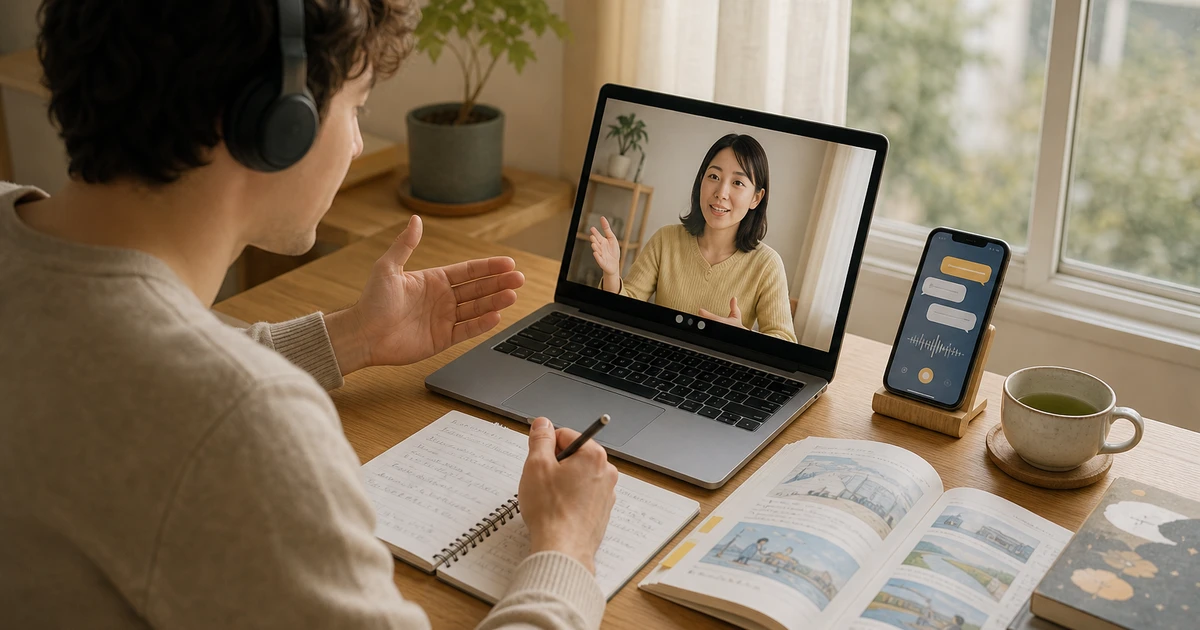
An AI Japanese tutor is useful for fast practice, but a human teacher is still better for speaking, pronunciation, politeness, and natural communication. The strongest answer is not “AI or human.” It is: use AI for repetition and preparation, then use a human teacher to check whether your Japanese works with real people.
This matters because Japanese is not only grammar. A sentence can be technically correct and still sound too direct, too distant, too stiff, or too casual for the situation. If you are deciding how much you can study alone, start with this broader guide on whether you can learn Japanese by yourself, then use this page to decide where AI support ends and human feedback becomes important.
Short Answer: Use AI for Drills, Humans for Communication
Use AI when the task has a clear answer; use a human teacher when the task depends on context. AI can explain grammar, generate examples, quiz vocabulary, make role-plays, and help you review at any time. A teacher can listen to your actual speech, catch repeated habits, adjust your tone, and help you speak naturally under real conversation pressure.
AI is enough for low-risk practice such as flashcards, example sentences, grammar review, and simple role-play. A human teacher is worth it when you need to know whether your sentence sounds natural, whether your pronunciation is clear, or whether your wording fits a friend, teacher, coworker, customer, host family, or interviewer.
A useful rule: if a mistake would only affect your private study, AI is probably fine. If the sentence will be spoken or sent to a real person, get human feedback.
How Current AI Japanese Tools Compare
Different AI Japanese tools solve different problems, so do not judge them as one category. Choose the tool by the skill you are training.
ChatGPT voice mode is useful for open-ended conversation practice, role-play, and quick explanations. You can ask follow-up questions and repeat a topic many times. Its limit is that pronunciation feedback may be general, and availability or features can change by plan, device, and app version.
Dedicated AI language apps are useful for guided drills, speaking prompts, streaks, and beginner-friendly structure. They are convenient when you want a clear path and quick practice. Their limit is that scenarios can feel narrow, and “correct” app completion does not always mean natural real-world Japanese.
Translation tools are useful for checking rough meaning and drafting a first version of a sentence. Their limit is tone. They may produce Japanese that is grammatically acceptable but not right for your relationship, level of politeness, or situation.
Flashcard and quiz tools are useful for memory. They help with vocabulary, kanji recognition, and grammar patterns. Their limit is production: recognizing an answer is easier than saying it smoothly in conversation.
When comparing tools, ignore hype first and check practical features: Can you control Japanese script, romaji, and English output? Can you practise by voice? Can you ask for naturalness notes? Can you review mistakes later? Can you export sentences for a teacher to check?
Decision Matrix by Learner Goal
Choose AI or a human teacher based on your goal, not based on which option feels more advanced.
For JLPT study, AI is enough for vocabulary quizzes, grammar explanations, reading checks, and sentence pattern review. A human lesson is worth booking if you pass written practice but freeze when asked simple questions aloud.
For business Japanese, AI is enough for first drafts, email structure, and polite phrase ideas. A human teacher is important for tone, relationship distance, interviews, meetings, and avoiding wording that sounds too blunt or too heavy.
For study abroad, AI is enough for campus vocabulary, self-introduction drafts, and daily-life role-plays. A human teacher helps you practise real responses for teachers, classmates, staff, and host families.
For travel, AI is enough for phrase preparation, restaurant questions, station phrases, and emergency vocabulary. A human teacher helps with pronunciation, listening repair phrases, and confidence before real interactions.
For daily conversation, AI is enough for casual role-play and topic practice. A teacher helps with turn-taking, reactions, pauses, and sounding like a person rather than a translated script.
For beginner speaking, AI is enough for kana, vocabulary, and simple sentence building. A teacher becomes valuable as soon as you start saying sentences aloud. If you are at this stage, use basic Japanese conversation practice for beginners to build simple speaking habits.
Phrases That Get Better Feedback
Ask specific questions, and both AI and human teachers will give better correction. These phrases are especially useful when you want natural Japanese, not just technically correct Japanese.
Japanese | Romaji | English meaning | Best use |
|---|---|---|---|
これで合っていますか。 | Kore de atte imasu ka. | Is this correct? | Basic grammar or word check |
もっと自然に言えますか。 | Motto shizen ni iemasu ka. | Can I say this more naturally? | When a sentence feels translated |
この言い方は失礼ですか。 | Kono iikata wa shitsurei desu ka. | Is this way of saying it rude? | Checking tone and politeness |
丁寧に言うとどうなりますか。 | Teinei ni iu to dō narimasu ka. | How would I say it politely? | Work, teachers, strangers, formal settings |
カジュアルに言うとどうなりますか。 | Kajuaru ni iu to dō narimasu ka. | How would I say it casually? | Friends and relaxed conversation |
発音を直してもらえますか。 | Hatsuon o naoshite moraemasu ka. | Could you correct my pronunciation? | Live speaking practice |
もう一度言ってもいいですか。 | Mō ichido itte mo ii desu ka. | May I say it one more time? | Repeating after correction |
A short cultural note: Japanese communication often depends on relationship distance and implied context. A sentence may be correct but still sound strange if it says too much, says too little, or uses the wrong level of politeness for the person in front of you.
Example Sentences: AI Drafts and Teacher Checks
Use AI-generated sentences as drafts, then ask a teacher whether they sound natural for your real situation. Here are common sentences learners may want to practise.
仕事の後で日本語を勉強したいです。
Shigoto no ato de Nihongo o benkyō shitai desu.
I want to study Japanese after work.
来週、日本語の面接があります。
Raishū, Nihongo no mensetsu ga arimasu.
I have a Japanese interview next week.
もう少しゆっくり話してもらえますか。
Mō sukoshi yukkuri hanashite moraemasu ka.
Could you speak a little more slowly?
この表現は仕事で使っても大丈夫ですか。
Kono hyōgen wa shigoto de tsukatte mo daijōbu desu ka.
Is this expression okay to use at work?
A human teacher can check whether these sentences fit your goal, then help you say them aloud with better rhythm. In a 25-minute one-on-one online lesson over LINE, Zoom, or Google Meet, you can practise AI-generated sentences and ask for real-time checks on pronunciation, wording, and politeness. To try that with a teacher, book a Free Trial Japanese lesson.
Common Mistakes with AI Japanese Tutors
The main risk is memorizing AI output before checking whether it sounds natural. Learners often copy the first translation they receive, then later discover it was too formal, too casual, too direct, or not quite right for the situation.
Another mistake is practising only by typing. Japanese conversation needs mouth movement, rhythm, listening, repair phrases, and quick response. If you read and type every day but rarely speak, your recognition may improve faster than your speaking ability.
Learners also confuse “polite” with “natural.” More formal Japanese is not always better. It can sound distant with friends, while casual Japanese can sound rude with teachers, coworkers, or people you have just met.
The best correction usually includes three parts: what was understandable, what sounded unnatural, and what to say instead. For more live speaking structure, use this guide to Japanese conversation practice for beginners.
Best Workflow: AI Before and After Human Lessons
The best workflow is AI for preparation and review, with a human teacher for live correction. This keeps lesson time focused on speaking, not searching for example sentences.
Use this simple routine:
- Ask AI for five sentences about your real life.
- Choose two you actually want to say.
- Read them aloud before your lesson.
- Ask your teacher to check naturalness and pronunciation.
- Practise the corrected version several times.
- Review the corrected sentence later with AI or flashcards.
Here are copy-ready prompts you can use with ChatGPT or another AI Japanese tutor:
Act as a careful Japanese tutor. Give me 5 beginner-friendly sentences about [topic]. For each one, include Japanese script, romaji, English meaning, naturalness notes, and politeness level. Add a reminder to verify important sentences with a teacher.
Check this Japanese sentence: [paste sentence]. Explain whether it is natural, what politeness level it has, and when I should or should not use it. Include Japanese script, romaji, English meaning, and a teacher-verification warning.
Create a short role-play for [travel / work / study abroad / daily conversation]. Ask one question at a time. After my answer, correct grammar, naturalness, and politeness. Show corrections in Japanese script, romaji, and English.
I am preparing for JLPT level [level], but I also want speaking practice. Give me 5 spoken questions using grammar from this level. Include Japanese script, romaji, English meaning, model answers, and naturalness notes.
Rewrite my sentence in three styles: casual, polite, and business-appropriate. Explain the difference in tone. Include Japanese script, romaji, English meaning, and tell me to verify important wording with a human teacher.
Make a pronunciation practice drill for this sentence: [paste sentence]. Break it into short chunks, include Japanese script, romaji, English meaning, rhythm tips, and a note that a teacher should check my actual pronunciation.
AI can make practice easier, but the teacher helps decide what to keep, what to adjust, and what your mouth can actually say under pressure. If you are comparing teachers, read how to choose a Japanese tutor online before booking paid lessons.
FAQ
Is an AI Japanese tutor enough for beginners?
An AI Japanese tutor can help beginners review vocabulary, ask grammar questions, and make simple sentences. It is not enough for pronunciation, rhythm, particles in real speech, and politeness habits. Beginners benefit from occasional human correction because early speaking mistakes can become automatic very quickly.
Can ChatGPT teach me Japanese conversation?
ChatGPT can simulate conversation, create role-plays, and respond by text or voice depending on your setup. It is useful for repetition and confidence. However, it cannot fully judge your real-life tone, relationship, facial cues, hesitation, or pronunciation quality the way a human teacher can.
What is the best AI Japanese tutor?
The best AI Japanese tutor is the one that fits your current task. Use voice chat for speaking practice, language apps for guided drills, translation tools for rough drafts, and flashcard tools for memory. For natural communication, the best system is still AI support plus human feedback.
Can AI replace a private Japanese teacher?
AI can replace quick reference tasks, but it cannot fully replace a private Japanese teacher for speaking. A teacher listens to your actual voice, notices repeated habits, asks follow-up questions, and adjusts Japanese to your goal, personality, relationship, and situation. That is where natural communication improves.
This standalone Kind Japanese guide sits outside the numbered beginner curriculum and helps learners choose the right mix of AI study and human instruction for real Japanese communication.
LEARN WITH OUR TEACHERS
Ready to use what you learned in a real lesson?
Friendly Kind Japanese teachers support you with live online lessons shaped around your level and goals.

Takeshi Matsuda
Registered Japanese language teacher

Mizuki Shimooka
Native Japanese speaker & English teacher