
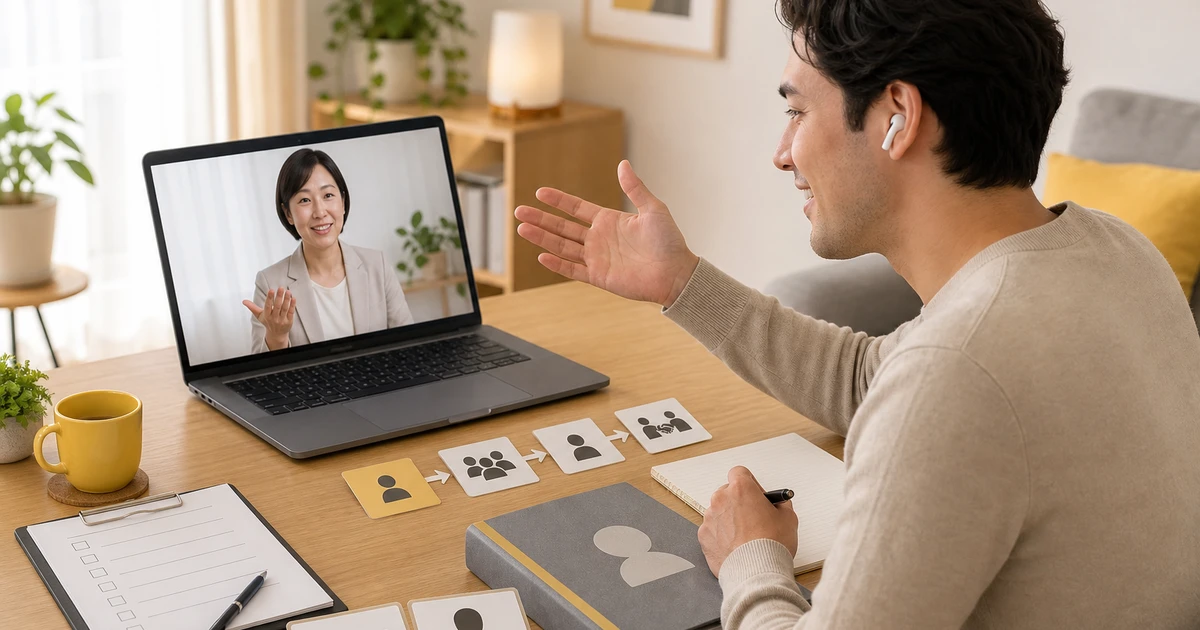
Online Japanese lessons for HR professionals should focus on workplace communication, not just general conversation. If your job involves interviews, onboarding, policy explanations, or employee support, you need Japanese that is clear, polite, and easy to adjust depending on the person in front of you.
A one-on-one tutor can help you practise the exact speaking situations that are hard to rehearse alone: asking interview questions naturally, explaining rules without sounding cold, checking understanding, and responding when someone gives an unexpected answer. Kind Japanese offers one-on-one online Japanese lessons over LINE, with standard lessons lasting 25 minutes, so HR learners can keep practice focused and practical.
Why HR Japanese Needs Targeted Practice
HR Japanese is different from travel Japanese or casual conversation because the stakes are relational. You are often representing a company, explaining sensitive information, or guiding someone through a process they may not fully understand.
For HR professionals, useful Japanese practice often includes:
- Interview openings and follow-up questions
- Onboarding explanations for documents, schedules, and workplace rules
- Policy explanations in clear, non-legal language
- Polite correction when information is missing
- Checking whether someone understood
- Softening direct statements without becoming vague
From a teacher's perspective, learners often know the grammar they need but struggle to produce it under workplace pressure. They may understand a polite sentence when reading it, then switch to overly casual Japanese when speaking quickly. That is exactly where role-play and teacher feedback matter.
If you are still building your foundation, it can help to review broader study options such as Japanese Lessons for Adult Beginners Online before focusing deeply on HR-specific scenarios.
What to Practise With a One-on-One Tutor
The most useful online Japanese lessons for HR professionals are built around realistic tasks. Instead of memorising long phrase lists, bring one situation and practise it several ways.
For interviews, practise:
- Greeting the candidate and explaining the interview flow
- Asking about experience without sounding too blunt
- Asking follow-up questions from a short answer
- Closing the interview politely
For onboarding, practise:
- Explaining what documents are needed
- Giving the first-day schedule
- Describing who to contact for different questions
- Confirming that the new employee understands
For policy explanations, practise:
- Explaining rules step by step
- Using neutral language for sensitive topics
- Avoiding overly legal or overly casual wording
- Rephrasing when someone looks confused
A strong practice loop is simple: speak, receive correction, repeat, then try the same message in a slightly different situation. This helps you move from “I know the phrase” to “I can use it while thinking about the person.”
Core HR Phrases for Workplace Role-Play
Use the phrases below as starting points for role-play, not as a script to read mechanically. In a lesson, a teacher can help you adjust politeness, speed, and word choice depending on whether you are speaking to a candidate, a new employee, or an internal colleague.
Japanese | Romaji | English Meaning |
|---|---|---|
本日はお時間をいただき、ありがとうございます | Honjitsu wa o-jikan o itadaki, arigatō gozaimasu | Thank you for your time today |
まず、面接の流れをご説明します | Mazu, mensetsu no nagare o go-setsumei shimasu | First, I will explain the interview flow |
これまでのご経験について教えてください | Kore made no go-keiken ni tsuite oshiete kudasai | Please tell me about your experience so far |
入社初日の持ち物をご案内します | Nyūsha shonichi no mochimono o go-annai shimasu | I will explain what to bring on your first day |
この規則について確認しましょう | Kono kisoku ni tsuite kakunin shimashō | Let’s confirm this rule |
ご不明な点はありますか | Go-fumei na ten wa arimasu ka | Do you have any unclear points? |
もう少し詳しく説明いたします | Mō sukoshi kuwashiku setsumei itashimasu | I will explain in a little more detail |
社内の担当者に確認します | Shanai no tantōsha ni kakunin shimasu | I will check with the person in charge internally |
本日はお時間をいただき、ありがとうございます。
Honjitsu wa o-jikan o itadaki, arigatō gozaimasu.
Thank you for your time today.
まず、面接の流れをご説明します。
Mazu, mensetsu no nagare o go-setsumei shimasu.
First, I will explain the interview flow.
入社初日の持ち物をご案内します。
Nyūsha shonichi no mochimono o go-annai shimasu.
I will explain what to bring on your first day.
ご不明な点はありますか。
Go-fumei na ten wa arimasu ka.
Do you have any unclear points?
A short cultural note: in Japanese workplace communication, politeness is not only about “being formal.” It also helps show role awareness. HR language often needs to be warm but structured, especially when explaining procedures or asking candidates to share information.
A Focused 25-Minute LINE Lesson Flow
A standard Kind Japanese one-on-one lesson is 25 minutes, which works well for one narrow HR situation. The goal is not to cover every possible workplace phrase in one session. The goal is to practise one realistic exchange enough times that your speaking becomes smoother.
A practical LINE lesson flow could look like this:
- Warm-up: briefly explain your HR role and the situation you want to practise.
- Target task: role-play one interview, onboarding, or policy explanation scene.
- Correction: review grammar, word choice, pronunciation, and politeness.
- Repeat: try the same scene again with improved wording.
- Learner-kept follow-up questions: note what you want to ask next time over LINE.
For scheduling, propose lesson windows in your own time zone clearly. For example, write that you are available on weekday evenings in your country, or give two or three possible windows with your time zone included. Avoid assuming the teacher will know your local schedule from your country name alone.
If you are preparing for your first trial conversation, the article Japanese Free Trial Lesson Questions to Ask can help you choose a focused goal before contacting Kind Japanese.
Common Mistakes
Learners often sound either too casual or too stiff in HR Japanese. The best correction is usually not “more keigo everywhere,” but better control: who are you speaking to, what is the situation, and how much distance is appropriate?
Using anime-style second-person words at work. Our teachers have seen learners bring in words from anime that are not suitable for normal HR conversation. Words like 君 (kimi, you), そなた (sonata, you), and あんた (anta, you) can sound rude, old-fashioned, or character-like depending on context. In HR situations, it is usually better to use the person’s name or title.
Explaining policies too directly. A sentence may be grammatically correct but feel cold. For policy explanations, practise softeners, clear sequencing, and confirmation questions so the other person can follow without feeling scolded.
Treating interviews like casual chat. Friendly is good, but interviews need structure. Practise transitions such as explaining the flow, asking one question at a time, and closing the topic before moving on.
Confusing kana shapes when reading names or documents. In our one-on-one lessons, teachers may review visual reading issues such as ぬ (nu) and め (me), or ね (ne) and れ (re), as shape confusions. For katakana, ツ (tsu) and シ (shi) are a common stroke-direction mix-up. These are reading and writing issues, not pronunciation pairs.
Skipping pronunciation checks for key words. HR language includes many formal compounds. Before a role-play, listen for long vowels, the timing of small っ (small tsu, pause marker), つ (tsu), す (su), and し (shi), and whether your sentence ending sounds final, questioning, or uncertain.
FAQ
Are online Japanese lessons useful for HR professionals?
Yes, if the lessons are task-based. HR professionals benefit most when online Japanese lessons include role-play for interviews, onboarding, and policy explanations. A one-on-one tutor can give teacher feedback on wording, politeness, pronunciation, and whether your message sounds clear in a workplace situation.
What should I prepare before a LINE lesson?
Prepare one realistic HR scene, not a broad topic. For example, choose “explaining first-day documents” or “opening an interview.” Write three English points you need to communicate, then try saying them in Japanese. This gives the lesson a concrete target and makes feedback easier to apply.
Can I practise interview Japanese without giving legal or hiring advice?
Yes. Language practice can focus on greetings, question flow, follow-up wording, and polite clarification without discussing legal decisions or company policy details. Keep the lesson about communication skills: how to ask, explain, confirm, and respond naturally in Japanese.
How can I start with Kind Japanese?
Choose one HR situation you want to handle better, such as interviews, onboarding, or policy explanations, and bring it as your first practice goal. You can book a Free Trial lesson with Kind Japanese over LINE and use the conversation to check your level, goal, and next practice step.
LEARN WITH OUR TEACHERS
Ready to use what you learned in a real lesson?
Friendly Kind Japanese teachers support you with live online lessons shaped around your level and goals.

Takeshi Matsuda
Registered Japanese language teacher
Mizuki Shimooka
Native Japanese speaker & English teacher